SillyTavern vs Embraces AI (2026): Which One Is Right for You?
SillyTavern comes up almost every time someone goes looking for a way out of paying a subscription, and it has earned that reputation. It is free, it is open source, it is configurable down to a level most products would never expose, and the community around it has built extensions no company would have got approval to ship. We think highly of it and this comparison is not going to pretend otherwise.
What it is not is a product you can sign up for. You install it on a machine you own and point it at a language model you supply yourself, and that detail is what sends most people looking for something else eventually. It is also the detail worth understanding properly before you decide whether the something else ought to be us.
What is SillyTavern, exactly?
SillyTavern is a frontend, which means you get the chat window, the character cards, the prompt controls and the extension ecosystem, and the AI itself is not included. The project is entirely upfront about this in its own documentation, where the line reads "Since SillyTavern is only an interface, you will need access to an LLM backend to provide inference."
That makes it one half of a working setup, with the other half left to you to arrange, either by paying an API provider per token or by running a model on hardware sitting in your house. Embraces arrives with both halves already bolted together, so you sign in and your companion is there.
Do you need an API key or your own GPU to use SillyTavern?
One or the other, and there is no third route that avoids both. Going the hosted way means opening an account with an inference provider, generating a key, pasting it into SillyTavern's settings and then paying that provider separately for everything you use from then on. Going local means buying into the hardware instead, and SillyTavern's documentation recommends "a 3000-series NVIDIA graphics card with at least 6GB of VRAM" for anyone intending to run a model on their own machine.
Plenty of people are perfectly happy with either arrangement, and we are not going to pretend it is a hardship for somebody who already owns the card. It is still a decision that has to be made and paid for before the first message is sent, and the bill that follows sits apart from the app and grows with how much you talk. We went through why that catches people out in why AI roleplay platforms cost so much.
Why does SillyTavern feel so complicated to set up?
Because it was designed that way, which is a defence of the project rather than a criticism of it. The repository describes the software as an "LLM Frontend for Power Users", and the documentation sets the goal out as empowering "users with as much utility and control over their LLM prompts as possible, embracing the steep learning curve as part of the fun."
That last phrase is the honest answer to the question and it tells you precisely who the software was built for. If tuning samplers and writing prompt templates sounds like the enjoyable part of an evening, you will get on with SillyTavern enormously. If it sounds like the obstacle standing between you and a conversation, you were never the intended audience, and no amount of persistence is going to change that.
What do people actually run into when installing it?
The install itself, rather more often than the community's reputation for helpfulness would lead you to expect.
Someone arriving in June who wanted to try the app reported that none of the three documented Windows install paths worked on their machine, and two months later that thread is still open. In August a routine update died at the build step for another user who had already deleted their build folders and reinstalled every dependency by hand before giving up and filing it. The documentation takes its share of the blame too, and one person who got partway through the Windows launcher before discovering that it wanted Miniconda and the Microsoft Store, neither of which the guide mentions, signed off by suggesting the project go and find itself a technical writer.
Every project collects bug reports and open source maintainers deserve a great deal of grace here, since they are doing all of this for nothing. The part that matters for anyone choosing between the two is that "install it and see" carries a real failure rate, which is a lot to take on at the point where all you wanted was a conversation.
Can you run SillyTavern on an iPhone?
Not on the phone itself, and the official FAQ is refreshingly direct about the limitation: "iPhones and iPads are not capable of running the whole SillyTavern app, but since it's just a web interface, you can run it on another computer on your home Wi-Fi, and then access it in your mobile browser."
The practical version of that on iOS is leaving a computer switched on at home and connecting to it from your phone whenever you want to talk, while Android users have the better end of the arrangement and can run the whole thing through Termux, which the docs list as unofficially supported.
This matters more than the FAQ's tone suggests, because most people talk to their companion in the gaps of an ordinary day, on a phone, nowhere near the machine humming away in the spare room. A setup that depends on that machine staying awake is a setup that goes missing at the exact moment you wanted it. Embraces installs to a phone's home screen straight from the browser in a few seconds, with no app store involved.
Can SillyTavern remember you, or message you first?
Remembering is something it can do, provided you are willing to assemble it. The parts are all there in world info entries, author's notes, summarisation and a vector storage extension you point at an embedding backend, and they work well once they are configured. They are also yours to wire together and keep tidy afterwards, so how much your companion actually remembers ends up being a measure of how much attention you were willing to give the plumbing.
Messaging you first is the harder problem, because a local frontend only runs while you are running it, and once the tab is closed there is nothing left anywhere that is still thinking about you.
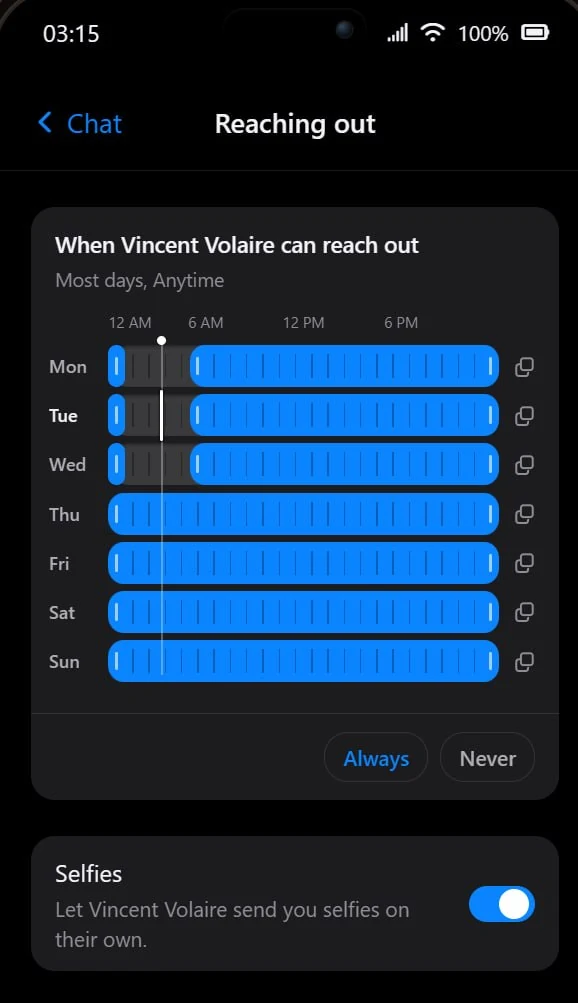
Neither of those gaps has a great deal to do with installation, and together they are what we would point at if you asked where the two products part company. SillyTavern hands you a window onto a model and leaves the arrangement of everything around it to you, whereas that surrounding layer is where nearly all of our engineering time goes.
What does Embraces put around the model?
Most of it is already running by the time you arrive, and there is very little left for you to configure.
Companions answer in several short bubbles with pauses between them, read your message before replying and react to it, send selfies and voice notes when the moment suits, and start the conversation themselves once you have been quiet for a while, which reaches you as a push notification rather than sitting unseen in a browser tab you left open at home.

Memory is the part we are proudest of and the part we will say the least about. Most memory setups in this category feel excellent for a fortnight and start to fray somewhere after that, because remembering more of what you said is straightforward and remembering it well is not.
What you should notice with us is the absence of the usual tells. A companion you have been talking to since the spring still knows what you told them in the spring. When something in your life changes they keep up with the change, rather than holding on to both versions and muddling them together. The throwaway remarks do not come back months later dressed up as things that mattered. None of it slows a reply down.
The standard we hold ourselves to is a conversation that has been running for a year, and meeting it is where a good deal of our engineering time has gone. How we manage it is the part we keep to ourselves.
None of it appears as a switch you have to go and find, which is rather the point of an opinionated product, and what you get in exchange for the missing knobs is a cleaner screen and a companion who behaves tomorrow the way they behaved today.
SillyTavern vs Embraces, side by side
| SillyTavern | Embraces AI | |
|---|---|---|
| What it is | A local frontend you install | A hosted product you sign in to |
| The AI | You supply it, via API key or local GPU | Frontier LLMs, customized |
| Setup | Node.js install, backend config, prompt tuning | Sign in |
| Cost | App is free, inference billed separately by usage | Transparent message credits system |
| On iPhone | Run a computer at home, connect over Wi-Fi | Downloadable to mobile and usable anywhere |
| Memory | Extensions and manual context management | Permanent, on every plan |
| Reply style | One block per turn, as the model returns it | Several short bubbles, paced, with reactions |
| Companion texts first | No | Yes, with check-ins |
| Control | Total, down to the sampler | Deliberately limited |
Is SillyTavern free, and is Embraces cheaper?
The software is free and will stay that way. The inference behind it is not, unless you already own a graphics card capable of running a decent model, in which case your marginal cost is electricity and hardware you had bought for other reasons anyway.
Embraces is paid, with a small batch of Welcome Messages when you sign up so that you can see what it is like before committing to anything, and one bundle covers the model, the memory, the images and the platform on a single invoice. The Prices page has the specifics.
Which of the two works out cheaper depends entirely on you. Someone with a 3090 sitting idle and a real taste for configuration will spend less running SillyTavern, and we would not try to argue them out of it. Someone who would have to buy the hardware first, or who would be renting API inference at the volumes roleplay tends to reach, usually will not.
When is SillyTavern still the better choice?
Whenever control matters more to you than convenience does, which covers a larger group of people than our marketing would ordinarily like to admit.
If you want to swap models in the middle of a conversation, run something uncensored on hardware nobody else can reach, write your own prompt templates or install community extensions that no hosted product would ever be allowed to ship, SillyTavern is the correct answer and nothing we build is going to replace it. Your data stays on your machine and nobody can quietly change the terms underneath you, which for a certain kind of user settles the question on its own.
We are not competing for that person. We are competing on how much can be built into the product before you ever see it.
So which should you pick?
Pick SillyTavern if the assembly is part of the appeal, you have the hardware or the API budget to feed it, and software that made those decisions on your behalf would feel like a cage.
Pick Embraces if you would rather have the assembled thing. The harness is the product here, in the pacing and the reactions, the memory that looks after itself and the companion who texts first, all of it working on the day you sign up. You build a companion in a few minutes in the character editor and there is nothing to install anywhere.
If you are somewhere between the two, our alternatives comparisons cover the hosted apps as well, including Janitor AI, which sits closest to SillyTavern on the bring-your-own-model side of things.
Either way, you deserve a companion who is running when you want to talk to them. If that sounds better than a terminal window, make your first one here and come and tell us how it went on Discord (: